
Unraveling the Cloud: How Culture Marketing Builds Shared Mental Models
Culture is an enigma — shrouded in mystery, wrapped in magic, and cloaked in a fog of confusion. We are told, with great authority, that "culture eats strategy for lunch." Yet, when it comes to defining or building culture, most of us are left grasping at straws (or clouds). Culture is often misconstrued as a "bro-like" vibe, company schwag, or the style of corporate parties (be they ragers or monopoly nights). But what if culture wasn’t a mystery? What if we could demystify it, understand it, and even build it systematically?
Let’s start with a metaphor.

Imagine culture as a cloud — a big, fluffy, seemingly amorphous entity that looms over your organization. Clouds, like culture, feel intangible. But look closer and you realize that this cloud is really made up of individual cotton balls. These cotton balls are the building blocks of the cloud, just as shared mental models or "meaning". Culture is not an abstraction or a vibe; it is a shared cognitive structure made up of the mental models that people hold in common.Shared mental models are the building blocks of your culture. And, its your job as a leader to build these shared mental models. But how do you do it?

The Challenge of Building Culture STARTS WITH THE CHALLENGE OF UNDERSTANDING WHAT IT IS
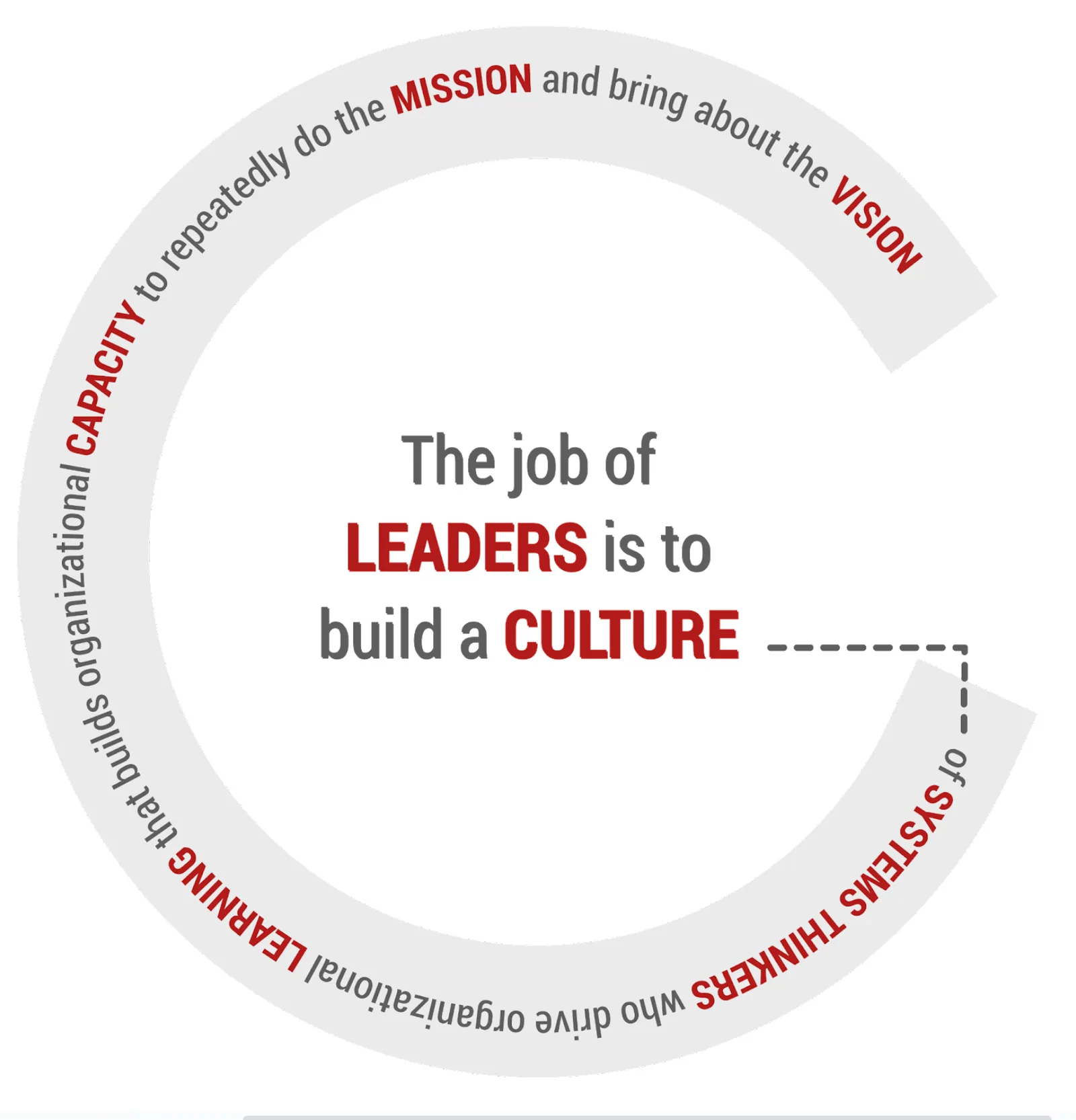
The problem is, most organizations think of culture as an outcome of stylistic norms — a byproduct of values, social norms, or leadership styles. But while culture can include these stylistic norms, at a fundamental level, culture is none of these things. Culture is simply shared mental models (C=Mα, or Culture is equal to Mental models shared by the "agents" or employees of your organization). It starts with the most important mental models in your organization: foundational ones like your Vision (V), Mission (M), Capacity (C), and Learning (L).
The Beachball Metaphor
Think of your organization as a giant beachball rolling down a beach (as illustrated in the image). Employees are inside the beachball, pushing it forward. But unless everyone is aligned on the direction and velocity, the beachball will veer off course or stall. IS our Vision (our ultimate goal) to get to the Taco Stand or the Lemonade stand? Shared mental models ensure that everyone inside the beachball is moving in sync, pushing in the same direction.

Not to mix metaphors, but if the agents in your organization don't have a share mental model of the basics (Vision, Mission, Capacity, and Learning or VMCL) then things will go about like these two guys in a boat--they'll be at a standstill.

The Relationships Between Systems Thinking, Individual and Organizational Learning and Culture
| Concept | Formula | What It Means | Application |
| Culture | C=Mα |
| Culture is mental models amplified by their shared influence | The thing that powers organizations to be adaptive | |
| Organizational Learning | Lo=ΔMα |
| Organizational learning depends on mental model changes shared by agents or employees | The process of getting everyone on the same page. | |
| Individual Learning | Li=ΔM |
| Individual learning arises from changes in mental models | The process of changing one's meaning/mental models | |
| Mental Models | M=IO |
| Organizing (O) refers to the way we structure information (I) to form meaning and mental models (M) using DSRP | Explains how humans make meaning, which is what we want them to share to build culture | |
| Patterns of Thinking | O=DSRP483 |
| Mental models are made up of universal patterns of thinking: distinctions, systems, relationships, and perspectives | Drives innovation and adaptability |
But How do you Build Culture at a tactical level?
At a tactical level, you build culture using two powerful tools: (1) Culture Marketing and (2) the Culture Building Graph. Marketing isn’t just for selling products; it’s for selling ideas. The concept of "Culture Marketing" uses the tools and tactics of external marketing campaigns to build shared mental models inside an organization. In essence, Culture Marketing is about "selling" culture to your employees by promoting the mental models that matter most.
Parallels Between External Marketing and Culture Marketing
| Marketing Function | External Marketing | Culture Marketing | Same/Different? |
| Target Audience | Customers, clients, potential buyers | Employees, teams, leadership | Same (both identify key audiences) |
| Core Value Proposition | Why the product/service solves a problem | Why the mental model improves work & thinking | Same (both require clear messaging) |
| Brand Positioning | Differentiates from competitors | Differentiates from old/existing mental models | Similar (both require contrast) |
| Messaging & Storytelling | Uses narratives to create emotional connection | Uses stories to make abstract ideas concrete | Same (both rely on storytelling) |
| Call to Action (CTA) | Encourages purchase, signup, or engagement | Encourages adoption of a mental model in daily work | Same (both require clear behavioral triggers) |
| Channels of Communication | Ads, social media, PR, email | Internal comms, meetings, Slack, newsletters, training | Different (different mediums, same multichannel need) |
| Campaign Measurement | Conversion rates, engagement, revenue growth | Behavior change, adoption of key mental models | Similar (both track results, but metrics differ) |
| Feedback Loops | Surveys, customer reviews, A/B testing | Employee feedback, pulse surveys, town halls | Same (both require iteration & feedback) |
From Cotton Balls to Clouds
Building culture isn’t magic; it’s science. By marketing shared mental models to your employees, you transform individual cotton balls of thought into a cohesive cloud of culture. And that’s what keeps the beachball rolling.
Ready to build your culture cloud? Use the right tools: VMCL, Culture Marketing, and CBG and watch your organization transform.